
Turf Toe
Summary
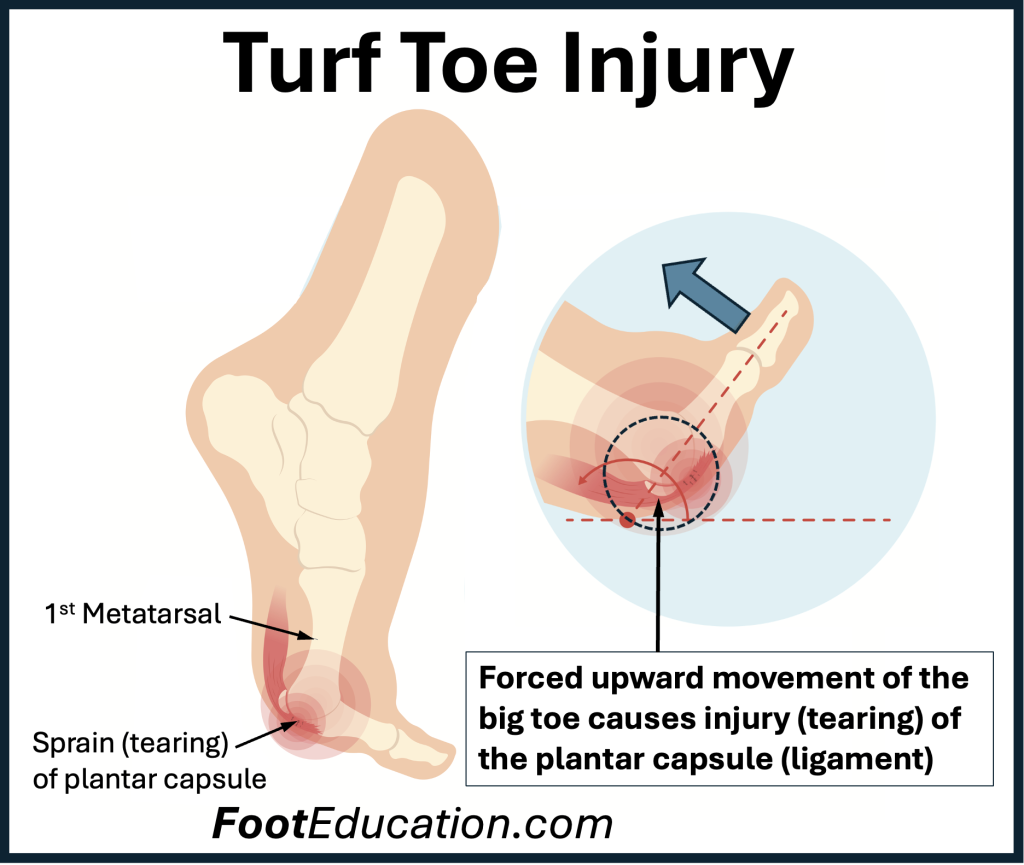
A Turf toe is an injury to the great toe joint. It occurs when the great toe is forced upward such as when an athlete cuts hard on artificial turf. With too much upward force on the great toe, the soft-tissues (capsule) lining the base of the great toe joint is injured or in some instances completely torn (Figure 1). This leads to pain and swelling in the toe. Treatment for partial tears of the capsule includes rest, ice, avoiding aggravating activities, taping or stiff soled shoes to limit movement. The recovery can be prolonged — often for as long as 2-8 weeks or more. Complete ruptures of the capsule require surgery and a prolonged recovery of 4-6 months.
Clinical Presentation
Turf toe injuries result in pain at the base of the great toe. They usually occur after an acute injury although repetitive forced upward movement of the great toe may also lead to an injury of the tissue (capsule) stabilizing the great toe joint. Turf toe is commonly seen in contact sports such as football, soccer, and rugby. It can also occur in high impact sports such as gymnastics and dance. Commonly an athlete will be changing direction suddenly on the playing field. The great toe will be forced upwards (Figure 1)as the rest of the foot rolls over the firmly planted toe. With enough force, the soft-tissues (capsule) on the under surface of the great toe will be torn either partially or completely. Patients will complain of pain in the great toe, swelling, a limp, and an inability to run.
Physical Examination
Patients with turf toe injuries will have pain in the great toe region especially at the base of the toe in the sole of the foot (the plantar surface). The great toe will often be swollen. Moving the great toe upwards will often create pain. If the capsule is significantly torn the great toe joint may be noted to be unstable. A noticeable limp may be observed as patients try not to put pressure on the injured area of their foot.
Imaging Studies
Plain x-rays should be reviewed to rule out other injuries such as sesamoid fractures and other fractures involving the great toe. However, x-rays in turf toe injuries are usually negative.
A stress x-ray or fluoroscopy may demonstrate excessive movement (instability) of the great toe joint when the great toe joint is stressed.
An MRI can reveal evidence of the soft-tissue (capsular) injury.
Classification of Turf Toe Injuries
A classification system has been presented by Clanton et al in 2007
- Grade 1: Attenuation of the plantar soft-tissue (capsule) of the great toe
- Grade 2: Partial tear of the plantar soft-tissue of the great toe
- Grade 3: Complete tear of the plantar soft-tissue with instability of the great toe joint
Treatment
Non-Operative Treatment
Non-operative treatment is usually effective for grade 1 and 2 turf toe injuries (partial tearing). The principles of treatment are to limit great toe movement while healing occurs and to control the symptoms of pain. Common non-operative treatment includes:
- Ice and Elevation: Acute injuries will benefit from ice and elevation to help decrease the swelling and allow for healing
- Rest and Activity Modification: Patients will initially often have to avoid all activities and in acute severe turf toe injuries, crutches are often needed.
- Limiting great toe motion: A Cast Boot (CAM Walker), or a rigid soled shoe can be used to limit motion through the great toe and protect the injured tissue while it heals. The extent of the injury and the time in the recovery process will usually determine which of these options is chosen. As the individual starts to return to sporting activity they will often benefit from taping the big toe and using a Morton’s extension splint. Both of these treatments are designed to limit the motion of the great toe and thereby protect it.
- Anti-inflammatory pain medications (NSAIDs): NSAIDs may be helpful to decrease the pain. Care must be taken to avoid taking too many NSAIDs not only can they be hard on your stomach, but there is some evidence that they may have an adverse effect on soft-tissue healing.
Operative Treatment
In Turf toe injuries where there is complete tearing of the plantar soft-tissues of the great toe, surgical repair may be needed. Turf toe injuries that do not adequately recover may benefit from turf toe surgery as well.
The surgery involves:
- Cleaning out any debris (cartilage fragments, etc.) that might be found in the great toe joint
- Repairing the torn soft-tissue (plantar plate or plantar capsule) at the base of the great toe.
Recovery can be prolonged and often involves:
- 6-8 weeks of non-weight-bearing or limited weight-bearing to allow the soft-tissue repair to heal followed by:
- 6-8 weeks of controlled rehabilitation while still protecting the repair in a boot or stiff soled shoe followed by:
- 6-8+ weeks of increasing controlled sports-specific exercises.
It is not uncommon for swelling to persist for many months after surgery. It is also not uncommon to have some residual symptoms even after a seemingly successful surgery. Unfortunately for some, a severe turf toe injury can be a career ending injury.
Potential Complications
The following general complications can occur:
- Infection
- Wound healing problems
- Blood clotting ( DVT or Pulmonary Embolism)
- Neuritis
- Complex regional pain syndrome
- Persistence of some symptoms due to the underlying joint injury
Potential complications that are specific to turf toe surgery include:
- Failure of the joint capsular repair
- Neuritis from an injury to a branch of the medial plantar nerve
Edited by Stephen Pinney MD, August 18th 2025. Previously Edited by Samuel Dellenbaugh MD and Patrick O’Connor, MD