
Stable Ankle Fracture
Summary
Stable ankle fractures involve a fracture of the outside bone of the ankle joint (the fibula). However, although the outside bone is fractured, the ankle joint itself remains well positioned and stable. They are associated with pain, resulting in it being very difficult or even impossible to walk on the ankle. Treatment is non-operative, although it often takes 6 weeks or more for the bone to heal. The total time to a complete recovery can be many months.
Clinical Presentation
Patients will usually report a twisting injury to the ankle. The foot may be rolled to the inside similar to an ankle sprain, or the foot may be fixed on the ground while the body rotates around it. In either case, patients will describe pain and swelling in their ankle. Often they will not be able to bear weight on the ankle, although in some cases they may be able to walk with significant pain.
Imaging Studies
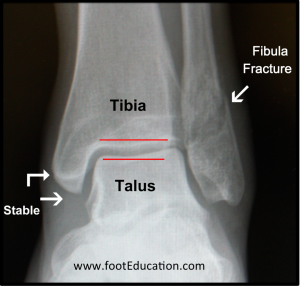
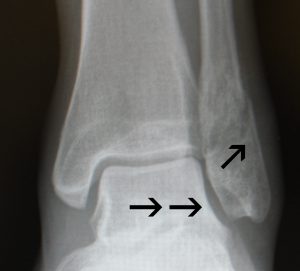
Plain x-rays of the ankle joint will identify a fracture (Figure 1) of the outer bone of the ankle (the fibula). However, the ankle joint itself will be intact and will be exactly where it should be. In some instances, the ankle joint will appear to be intact, but the joint will displace when it is stressed, demonstrating that the ankle fracture is actually unstable.
Figure 1: Plain X-Rays of a Stable Ankle Fracture
Types of Stable Ankle Fractures
There are two common types of stable ankle fractures:
- Pulling Fractures of the Fibula (Avulsion or Weber A type fractures). These injuries are equivalent to a severe ankle sprain. The main difference is that instead of the outside ankle ligament tearing, the ligament pulls a piece of the fibula off.
- Twisting Fractures of the Fibula (Weber B1-type fractures). In these fractures, the foot (and therefore the lower bone of the ankle) is fixed on the ground while the body (and therefore the two upper bones of the ankle) rotates inwards, causing the outer ankle bone (the fibula) to break (Figure 2). However, the rotation stops before the structures on the inside of the ankle are injured. Therefore the ankle joint itself remains anatomically positioned and stable.
Figure 2: Twisting Mechanism of Injury
Treatment
Stable ankle fractures may be treated without surgery because the ankle joint itself remains truly stable. If the joint is displaced or if there is some question about the integrity of the ankle joint, then surgery is often indicated.
Non-Operative Treatment
- Relative immobilization. Non-weight bearing or limited weight-bearing will limit pain, and allow the fracture to heal without being subject to excessive motion. Commonly, a walking boot such as a CAM walker is used.
- Ice. Ice is used to decrease the blood flow to the ankle and therefore decrease the swelling. A certain amount of blood flowing to the ankle is important, however, in patients who have recently suffered an ankle fracture, there is often too much blood flowing to the area.
- Elevation. Elevation will help limit the swelling and thereby decrease the pain. In general, the ankle should be elevated 6-12″ inches above the heart (i.e. with the foot on a pillow when you are lying down)
- Early Range of Motion. The ankle joint itself is stable so early motion can help prevent stiffness and allow muscle strength to be retained.
- Time. Bones that are broken (fractured) just take time to heal. Usually, it takes a minimum of 6 weeks before a bone, such as the fibula, to heal enough to withstand normal everyday forces (ex. normal walking) through the ankle joint. However, it often takes many months for the fracture, soft-tissues, and muscle strength to return to pre-injury levels.
- Rehabilitation. Aggressive rehabilitation working on regaining lost strength, motion, and proprioception, is often instituted after the bones have healed enough to withstand these forces (often 6 weeks). This type of rehabilitation program is often overseen by a physical therapist.
Edited by Stephen Pinney MD on August 4th 2026.