
Lisfranc Fracture ORIF
Edited by Gregory Waryasz MD
(ORIF is “Open Reduction Internal Fixation” – opening the injured area surgically, reducing the bones and joints to their proper position, and placing screws and plates internally to fix them in that corrected position)
Indication
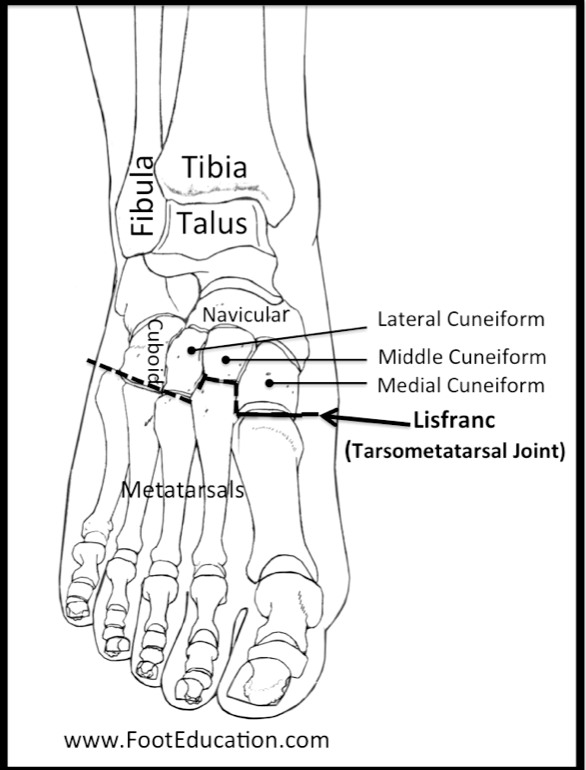
The Lisfranc joints are located in the midfoot (Figure 1). The main indication for this ORIF of the Lisfranc joints is a displaced or unstable Lisfranc fracture, or a dislocation. The purpose of the surgery is to reposition the bones and joints in the mid-part of the foot, allowing the associated torn ligaments (the strong tissues that hold these bones together and support the arch) to heal. A missed or not treated Lisfranc injury can lead to a loss of the arch of the foot (flatfoot). In order to treat some injuries, mid-foot fusion may be recommended where some of the joints are permanently placed together.
Figure 1: Lisfranc Joints
Procedure
The location of the incision is dictated by both the location of the fracture and the location of the joints that are disrupted. If all five of the Lisfranc joints are disrupted, then two or three incisions on the top of the foot may be needed; one on the top inside and inside border of the foot, and one on the top outside of the foot. If the first three tarsometatarsal joints are disrupted, then only one or two incisions are made on the top and/or inside aspect of the foot.
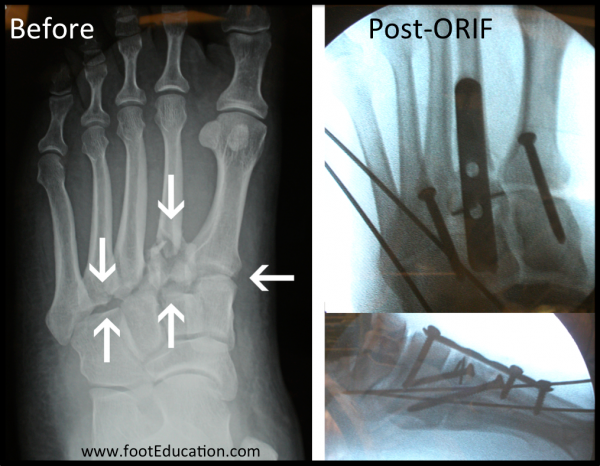
Once the disrupted tarsometatarsal joints are identified, the dissection is carried down to the involved joints and the debris is cleaned out. The disrupted joints are repositioned back to the position they were in prior to the injury. The joints are then fixed with screws, plates with screws, suture based implants, and/or pins (Figure 2). Depending upon the type of injury and time when being fixed, some joints may need to be put together permanently (fusion). One exception is a disruption of the 4th and 5th tarsometatarsal joints; in this case, the bone is provisionally fixed with wires. The wires are then removed after about six weeks so that some movement of these joints can be encouraged. Regaining flexiility of the outside joints of the foot is important for walking.
Figure 2: Lisfranc injury treated with ORIF, Before (left) and Post-ORIF (right)
Recovery
Recovery from surgery to fix a Lisfranc fracture, subluxation, or dislocation can vary depending on the severity of the original injury, and the stability of the fixation. However, a typical recovery might include:
0-6 (or 8) weeks Post-Surgery
The patient is non-weight bearing to allow for adequate healing of the bones and of the disrupted ligaments. The ligaments actually require a longer time to heal.
6 (or 8) – 10 (or 14) weeks Post-Surgery
The patient can begin to weight-bear as tolerated, provided the foot is protected in a walking boot, such as a CAM walker. This boot (characterized by a rigid sole and a rocker-bottom contour) serves to disperse the force away from the middle of the foot and up the leg. Some surgeons may add an arch support to the boot.
10 (or 14) + Post-Surgery
At the 10-14 week mark, the patient can then transition into a stiff soled shoe.
A displaced injury takes a number of months of recovery.
For most Lisfranc injuries, about 70% of the recovery occurs in the first 6 months, but it is often a year or more before our patient has reached their point of maximal improvement following a significant Lisfranc injury. If fixed, some patients may require removal of the hardware to help regain motion of the joints.
Potential General Complications
- Asymmetric Gait (leading to pain elsewhere)
- Deep Vein Thrombosis (Blood Clot)
- Failure to Resolve ALL Symptoms
- Pulmonary Embolism (PE)
- Wound Healing Problems
Potential Specific Complications
- Nerve Injury. Injury to the nerves between the 1st and 2nd metatarsals (deep peroneal nerve), and on the top inside aspect of the 1st metatarsal (medial branch of the superficial peroneal nerve), can occur due to the placement of the incisions. Nerve injury can occur due to retraction, direct injury, or from scarring during the recovery process. If these nerves are injured or cut, the patient could end up with numbness or pain along the path of the nerve.
- Broken Hardware. Although screws are inserted to help stabilize the joints in an ORIF, they are not fused together. Movement is encouraged through the healing process, and the incorporated screws may have a potential to break. Although removal of the screws may be necessary, judgment is critical since removal of the screws will weaken the midfoot. In the setting of a Lisfranc injury treated by fusion, the hardware typically is not removed unless symptomatic.
- Midfoot Collapse. Related to the complication of broken hardware prior to adequate healing or incompletely treated injuries, the weakened midfoot has the potential to collapse through the tarsometatarsal joint leading to usually loss of the arch.
- Painful Hardware. Pain may be associated with the screws that are used to secure the joints. This occurrence is much higher in a Lisfranc injury because the hardware has a higher tendency to be more prominent than other parts of the foot.
Previously edited by Judy Smith, MD
Edited June 19, 2017
mf/3.5.18