
Hallux Rigidus
(Hallux Limitus)
Sommaire
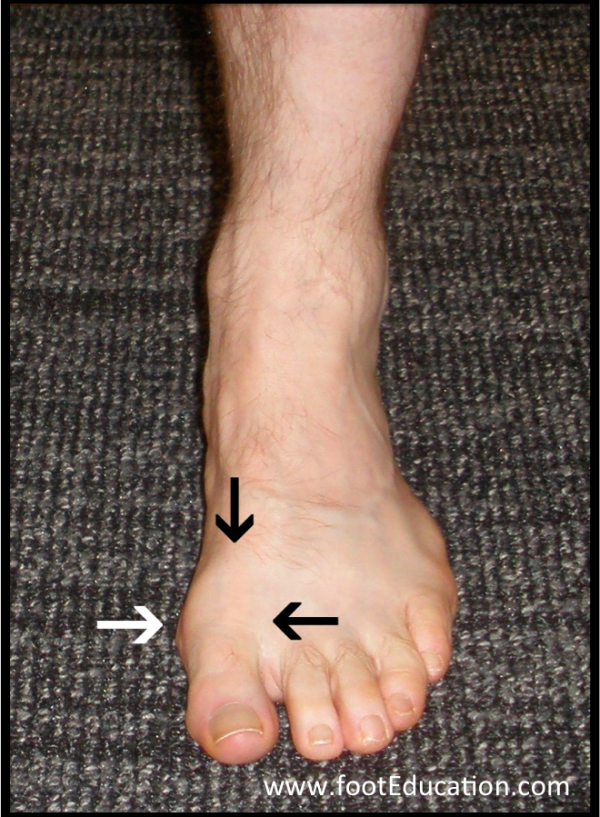
L’hallux rigidus est essentiellement une arthrose progressive entraînant une raideur et de la douleur dans le gros orteil (figure 1A – première articulation MTP). La perte de cartilage, qui survient d’abord dans la moitié supérieure de l’articulation, est secondaire à une contracture répétitive lorsque le gros orteil tente de bouger vers le haut lors de la marche. Cela peut prendre plusieurs années à se développer, mais peut devenir très symptomatique. Dans les derniers stades de cette maladie, le cartilage qui couvre le reste de la surface articulaire s’érode également, entraînant une arthrose de l’articulation qui s’empire et devient problématique.
Présentation clinique
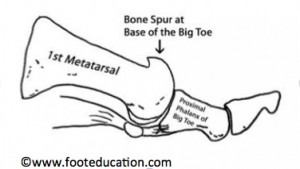
Les patients avec hallux rigidus vont se présenter avec de la douleur, de la raideur et de l’oedème dans l’articulation du gros orteil. Ces symptômes sont aggravés par l’activité qui requiert des mouvements répétitifs vers le haut du gros orteil comme la marche prolongée. L’oedème survient habituellement sur la moitié supérieure de l’articulation, et est souvent associé à une formation d’excroissances osseuses reconnues comme « nouvelle proéminence » par le patient. (Voir figure 1B).
Un examen physique révélera une limitation du mouvement du gros orteil qui sera également douloureux, particulièrement lorsque le patient est en mise en charge (voir figure 2). Les excroissances osseuses proéminentes (ostéophytes) sur le dessus (aspect dorsal) de l’articulation sont habituellement visibles et palpables. Il est très commun de voir ces signes sur les deux pieds, mais habituellement un pied est plus symptomatique que l’autre. Une douleur à la palpation est fréquente sur l’articulation du gros orteil oedémacié.
Imagerie
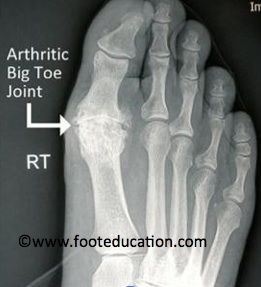
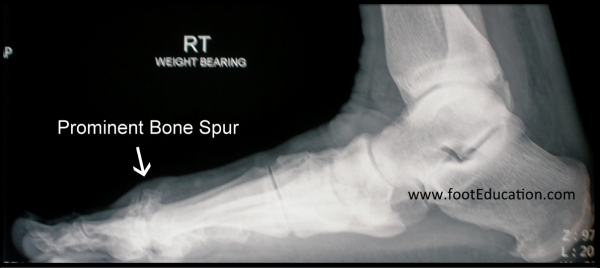
Des rayons-X du pied en mise en charge vont typiquement démontrer une perte du cartilage de la première articulation MTP, vu comme un amincissement de l’espace sur le rayon-X, comparativement aux autres espaces articulaires des articulations normales adjacentes. La tête métatarsienne peut devenir plus carrée sur le rayon-X antéro-postérieur. La vue latérale démontre souvent des excroissances osseuses dorsales proéminentes (voir figure 3).
Traitement
Traitement non-chirurgical
Dans la majorité des cas, l’hallux rigidus peut être traité de manière non-chirurgicale. Le principe du traitement non-chirurgical est de diminuer l’inflammation dans l’articulation arthrosique en limitant les mouvements à travers cette articulation. Le traitement non-chirurgical efficace est plus souvent :
- Limiter le mouvement du gros orteil. La douleur associée avec le mouvement de cette articulation peut être limitée avec l’usage d’un soulier à semelle rigide avec un contour légèrement en berceau. Alternativement, une barre rigide peut être appliquée à la chaussure, une plaque peut aussi être insérée sous l’orthèse, ou une orthèse avec une extension de Morton peut aussi être utilisée. Chacun de ces produits sert à diminuer ou éliminer le mouvement douloureux du gros orteil atteint d’hallux rigidus.
- Utilisation de chaussure avec un espace large pour les orteils fait de tissus souples peut aussi être utilisée pour permettre plus d’espace pour le gros orteil et ainsi limiter l’irritation de cet orteil oedémacié.
- Médication anti-inflammatoire. L’usage de médication anti-inflammatoire en vente libre peut aussi être utile pour améliorer les symptômes.
- Injection de corticostéroïdes. L’amélioration à court terme des symptômes peut aussi être obtenue à l’aide d’injection de corticostéroïdes ou d’acide hyaluronique dans l’articulation dans la première articulation MTP. Malheureusement, ces traitements n’entraînent pas d’amélioration prévisible à long terme pour les symptômes du patient et ont donc une indication limitée. Ils peuvent, par contre, apporter un soulagement significatif des symptômes à court terme – mais ils ne sont pas recommandés pour un usage répétitif à long terme, même s’ils sont efficaces, à cause de leurs effets secondaires cumulatifs potentiels.
Traitement chirurgical
Quand les patients échouent le traitement non-chirurgical, des options chirurgicales raisonnables sont disponibles et doivent être considérées. Il y a trois grandes catégories de traitement chirurgical. Ils incluent :
- cheilectomie dorsale de la première MTP (résection des excroissances osseuses)
- fusion de la première articulation MTP
- arthroplastie de la première articulation MTP (remplacement de la première articulation MTP).