footEducation
Home
Foot and Ankle Basics
Anatomy
Bones of the Foot
Joints of the Foot
Ligaments of the Foot
Muscles and Tendons of the Foot
Biomechanics of the Foot
Evolution of the Foot
Equinus Contractures
Glossary of Terms
Foot and Ankle Patient Education Handouts
Surgical Complications
Physical Therapy
Calf Stretch
Double Leg Heel Rises
Figure of Eight Exercise
Heel to Heel Inversion
Plantar Fascia Stretch
Proprioception
Resisted Eversion
Resisted Inversion
Scar Massage
Toe Flexibility Exercises
Agressive Athletic Rehab for Achilles Tendon
Non-Operative Protocol for Flatfoot Deformity
Medical Supplies
Cam Walker (Walking Boot)
Metatarsal Pads
Ankle Taping
Non-Operative Treatment
Post Surgical Issues
Pain Control Post-Surgery
Foot and Ankle Conditions
Acute Conditions
Achilles Tendon Rupture
Ankle Fracture
Ankle Sprain
Calcaneal Fracture
Lisfranc Fracture
5th Metatarsal Fractures
Stress Fractures
Chronic Conditions
Achilles Tendonitis
Acquired Adult Flatfoot Deformity
Ankle Arthritis
Ankle Instability
Bunions (Hallux Valgus)
Claw Toes
Diabetes
Hallux Rigidus
Metatarsalgia
Morton's Neuroma
Peroneal Tendonitis
Plantar Fasciitis
Rheumatoid Arthritis
Talar OLT
Tarsal Tunnel Syndrome
OTHER FOOT and ANKLE CONDITIONS A-Z
Foot Pain Identifier
Surgical Procedures
Achilles Tendon Repair
Ankle Arthroscopy
Ankle Fracture Surgery
Ankle Fusion (Arthrodesis)
Ankle Replacement
Bunion Procedures
Calcaneal Osteotomy
Foot Fracture Surgeries
Great Toe Cheilectomy
Lateral Ligament Reconstruction
Subtalar Fusion
Tendon Transfers
Triple Arthrodesis
OTHER SURGICAL PROCEDURES A-Z
FAQ
Resources
Editors
Home
...
Foot and Ankle Basics
...
Foot and Ankle Physical Therapy
...Double Leg Heel Rises
Double Leg Heel Rises
Indications:
Double leg heel raises are performed to strengthen the calf muscle. These muscles are often weak following immobilization after surgery or injury. Injuries such as Achilles tendon ruptures and Ankle fractures often require a concerted effort at calf stretching during the recovery period. In addition this exercise can strengthen the tibialis posterior (posterior tibial tendon) muscle which is often weak and dysfunctional in patients with acquired adult flatfoot deformity.
How it is done:
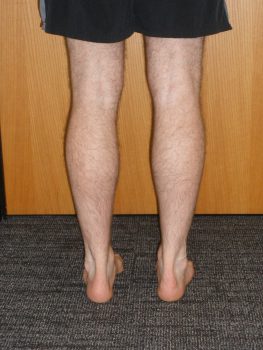
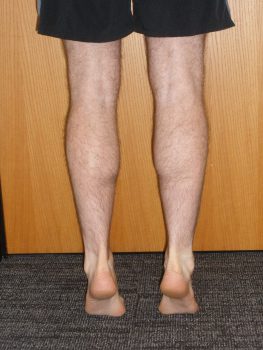
Use your calf muscles to slowly raise both your heels off of the floor, then slowly bring your heels back to the ground and repeat again. If one leg is weaker or recovering from injury then take the majority (70-80%) of the body weight on the uninjured side.
Perform the double leg heel rise exercises every second day (3-4 times per week). Start with a low number of repetitions (ex. 5-10) and sets (3-5) and gradually work up until you are doing many repetitions (20-30) and many sets (10-12). It can take many months to work up to doing a large number of repetitions. The calf muscle can be slow to regain strength often requiring many months to regain most lost strength.
Some patients may benefit from performing calf raises with their heels hanging off the edge of a rung of stairs. This works the calf muscle over a longer excursion. It may be beneficial in certain conditions such as Achilles tendonitis